
It’s time to have a conversation about consent and respectful relationships.
Consent means to get someone’s permission to do something. It is an ongoing process that’s important in all kinds of everyday situations, where boundaries are set and expectations marked out. Consent to sexual activity is no different and is one of the most important conversations we need to have with our sons today.
More formally, sexual consent is defined as:
“A free, voluntary and informed agreement between people to participate in a sexual act. This agreement is only present when these people mutually and genuinely want to engage in that sexual act, and actively ensure their partner does too”.[1]
In Victoria, affirmative consent laws were introduced in 2023, as well as some reforms to clarify circumstances where there is no consent to an act, such as ‘stealthing’[2], as well as stronger offences around the sharing of intimate images and deepfake imagery. These laws put responsibility onto each person to actively seek consent from the other people involved in any kind of sexual act.
Affirmative consent can look like: verbally asking and getting a ‘yes’, a physical gesture like a nod, reciprocating a move like removing clothes.[3] Consent can, however, be given or withdrawn at any time, so it’s essential to keep checking in.
It is also important to remember that consent is not transferrable and does not apply automatically just because you may have consented previously. It is not just for new relationships/interactions – affirmative consent should still be sought in every sexual interaction, even in long term relationships.
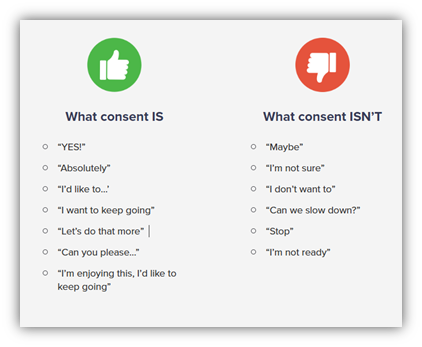
Infographic: Kids helpline: All about consent | Kids Helpline
The 5 core concepts of consent are:
- Consent is free and voluntary.
- Consent is clear and informed.
- Consent is affirmative and communicated.
- Consent is ongoing and mutual.
- Consent is given by someone able and capable.
Here is a helpful consent checklist from Kids Helpline:
- Ongoing – consent needs to be given before and during sexual activity
- Mutual – everyone involved agrees – enthusiastically!
- Enthusiastic – it’s wanted by everyone involved
- Certain and clear – there are no mysteries or doubts
- Freely given– there’s no pressure, guilt, or threats e.g. “I’ll break up with you if you don’t do this”
- Informed– everyone understands what’s happening
- Specific – saying yes to one thing doesn’t mean saying yes to another thing
g. agreeing to kissing doesn’t mean you have consented to sex - Reversible – you can say no at any time – it’s ok to change your mind
What the law says: Age of Consent
The age of consent is the age at which you are legally able to have sex.
In Victoria:
Source: https://yla.org.au/vic/topics/health-love-and-sex/sex/ |
Parenting: Respectful Relationships and Understanding boundaries
According to a Harvard University study, generally it was found parents were not discussing basic issues related to consent (Wesissbond et al, 2017).
Further, research shows that:
- Parents often feel that their kids will come to them, but children want parents to initiate these conversations.
- Successful communication with your son occurs when you are clear and direct and also when you listen and invite questions.
- If your son is same-sex attracted, it can be very upsetting if the parent does not again raise the subject.
Source: Wildman et al 2015
So, where to start?
Teaching about the factors that contribute to an understanding of consent can, and should, occur from an early age. These factors include body awareness, privacy, labelling of body parts, what is and isn’t ‘ok’ in terms of boundaries as well as how men and women are depicted in life and culture. We know that even as early as ages 2-3 gender labelling occurs (Kuhn et al, 1978) and that children’s sense of how gender intersects with different roles and qualities (for example, that to be masculinity is ‘hard’ and femininity is ‘soft’) occurs (Leinbach et al, 1997).
Home is where our children feel safe and provides the context for many moments we can talk about boundaries, about gender and consent. Also, whilst our boys learn about sexuality at school, they also learn about it online. Sadly, there is a very high chance that your son will easily be able to see sexually explicit images, pornography or worse. With the amount of time that your son may spend online, it is very important that as parents we provide the messages that: we treat people with respect and you can always talk to me if you are concerned or worried about anything.
To assist you in knowing where to start, the summary below is a guideline:
Early years:
- Use the correct labelling for body parts. This is because when we use different or coded words, it can cause confusion and make it seem that there is something secretive about it.
- Reinforce the idea of body ownership: every individual has control over their body.
- A simple action here is to underline that ‘no means no.’ If your child asks you to stop tickling them, then model that.
- Talk to them about the importance of ‘telling’ and that different levels of access to them is ok. For instance, a hug from mum or dad is different to that from a stranger.
Upper primary/lower secondary years:
- In these years it is possible to talk about permission, consent and coercion. You can talk about physical boundaries, but also personal boundaries.
- You can talk about gender roles and responsibilities. This is important as a lack of understanding of diversity of roles and responsibilities can lead to misconceptions about consent (in that men are dominant, for instance).
- In films, where objectification occurs, talk openly with your son about the way in which the female characters are portrayed and what that means
Middle to upper secondary years:
- Talk about power dynamics in relationships and what a healthy relationship looks like.
- Check in with them about the content they have covered at school.
- Discuss the role of alcohol (and drugs) and the potential effect this can have on the understanding of boundaries and giving, as well as providing, affirmative consent.
For more information, please visit the links below or talk to your health care professional.
Resources and some further important contacts
- Teach Us Consent: A good video on practising consent and what ‘no’ looks like
- Headspace: Understanding sexual consent factsheet
- Victoria Police: Safety tips when meeting someone from online
- Victoria Police: Image based sexual offences | Your safety | Victoria Police
- Kids Helpline provides free and private counselling to young people up to age 25. You can talk to them about anything that’s affecting you at any time, day or night on 1800 55 1800.
- 1800Respect is a national helpline, providing counselling, information and support. You can call them on 1800 737 732, 24 hours a day, 7 days a week.
- 1800MYLINE is a national helpline for sexual assault, family & domestic violence, available 24/7. They provide counselling, advice, or referrals to helpful services. You can call them on 1800 695 463, 24 hours a day, 7 days a week.
- Family Planning Victoria is a clinic that provides sexual healthcare (safe sex) services and advice. You can them on (03) 9257 0100 or e-mail them at fpv@fpv.org.au
Disclaimer: This document is of a general nature only. Whilst every effort is made to reflect current recommendations and legislation, please seek advice for your individual circumstances.
Endnotes
[1] The Commonwealth Consent Policy Framework: Promoting healthy sexual relationships and consent among young people, The Commonwealth Consent Policy Framework | Department of Social Services [accessed: 3.2.26]
[2] Affirmative Consent Model Now Law in Victoria | Premier
[3] What does it mean to give consent? | Respect Victoria
References
Commission for Children and Young People Teach your child how to keep themselves safe https://ccyp.vic.gov.au/assets/resources/tipsheet-teach-child-keep-safe.pdf (accessed 2026)
Raising Children Network. Consent and sexual consent: talking with children and teenagers (Suitable for 2-18 years) https://raisingchildren.net.au/school-age/connecting-communicating/tough-topics/sexual-consent-how-to-talk-with-children-teens (accessed 2026)
https://kidshelpline.com.au/teens/issues/what-consent (accessed 2026)
Widman L, Choukas-Bradley S, Noar SM, Nesi J, Garrett K. Parent-adolescent sexual communication and adolescent safer sex behavior: a meta-analysis. JAMA Pediatrics. 2015;1:1–10. doi: 10.1001/jamapediatrics.2015.2731
Youth Law Australia. (2024, November 20). Sex and dating. https://yla.org.au/vic/topics/health-love-and-sex/sex/ (accessed 2026)
Sex, Young People and The Law (2018). Victorian Legal Aid
Resilience, Rights and Respectful Relationships Curriculum (2018). Published by the Victorian Department of Education and Training
https://parents.au.reachout.com/friendships-and-dating/sex/how-to-teach-your-teenager-about-consent (accessed 2026)
Weissbourd R, Ross Anderson T, Cashin A, McIntyre J The Talk: How Adults Can Promote Young People’s Healthy Relationships and Prevent Misongyny and Sexual Harassment Harvard University Graduate School of Education 2017
Kuhn D, Nash SC, Brucken L Sex role concepts of two- and three-year-olds. Child Dev. 1978
Signorella ML, Bigler RS, Liben LS. Developmental differences in children’s gender schemata about others: a meta-analytic review. Dev. Rev. 1993;13:147–83
Department of Social Services. 5 core concepts of sexual consent. https://www.dss.gov.au/sexual-consent/5-core-concepts-sexual-consent (accessed 2026)
Resources
The role of the parent during this time of change
What should you be focusing on?
Crowther Centre
4 minute read
Do you want to be part of our Staff Development Network?
Sign up to receive our newsletter